

How to Calculate Your Carbon Emissions in Five Easy Steps for Carbon Reporting
As governments, investors, and customers increasingly expect companies to measure their environmental impact, carbon reporting is becoming an essential part of modern business operations.
Whether you are preparing for ESG disclosure, sustainability reporting, or internal environmental management, understanding how to calculate your organisation’s carbon footprint is the first step.
Fortunately, measuring emissions does not need to be complicated. By following a clear process based on internationally recognised frameworks such as the Greenhouse Gas (GHG) Protocol, businesses of all sizes can calculate their emissions accurately.
In this guide, we explain how to calculate your carbon emissions in five simple steps, helping you build a reliable foundation for carbon reporting.
Step 1: Define Your Carbon Reporting Boundaries
The first step in calculating your organisation’s carbon emissions is defining what parts of the business are included in your carbon report.
This process establishes both your organisational boundaries and your operational boundaries.
Most companies follow the GHG Protocol, which categorises emissions into three scopes:
Scope 1 – Direct Emissions
These are emissions produced directly by your organisation.
Examples include:
Fuel used in company vehicles
Gas used for heating buildings
Diesel generators or onsite combustion equipment
Scope 2 – Indirect Energy Emissions
Scope 2 emissions come from the electricity, heating, or cooling that your company purchases.
Even though the emissions occur at the power plant, they are attributed to the organisation consuming the energy.
Scope 3 – Indirect Value Chain Emissions
Scope 3 emissions occur throughout the supply chain and business activities.
Examples include:
Business travel
Employee commuting
Purchased goods and services
Waste disposal
Logistics and transportation
Defining these boundaries clearly ensures that your carbon reporting is consistent and transparent.
Step 2: Collect Your Activity Data
Once your reporting boundaries are defined, the next step is gathering the activity data that generates emissions.
Activity data measures how much energy or resources your business consumes.
Typical examples include:
Electricity usage measured in kilowatt-hours (kWh)
Fuel consumption in litres
Gas usage for heating measured in kWh or cubic metres
Flight travel measured in distance travelled
Waste measured in kilograms or tonnes
This data can usually be found in:
Energy bills
Fuel purchase records
Travel reports
Waste collection statements
Accurate activity data is essential because it forms the basis for calculating your carbon footprint.
Step 3: Apply Carbon Emission Factors
Once you have collected activity data, the next step is converting that information into carbon emissions measured as CO₂ equivalent (CO₂e).
This is done using emission factors, which estimate how much greenhouse gas is produced per unit of activity.
The basic formula is:
Emissions = Activity Data × Emission Factor
For example:

Emission factors are typically published by recognised sources such as:
UK DEFRA emission factor database
International Energy Agency (IEA)
Environmental Protection Agency (EPA)
GHG Protocol
Using standard emission factors ensures your carbon calculations align with recognised reporting standards.
Step 4: Calculate Your Total Carbon Emissions
Once emissions have been calculated for each activity source, the next step is to aggregate the results to determine your organisation’s total carbon footprint.
Your emissions should normally be grouped by scope:
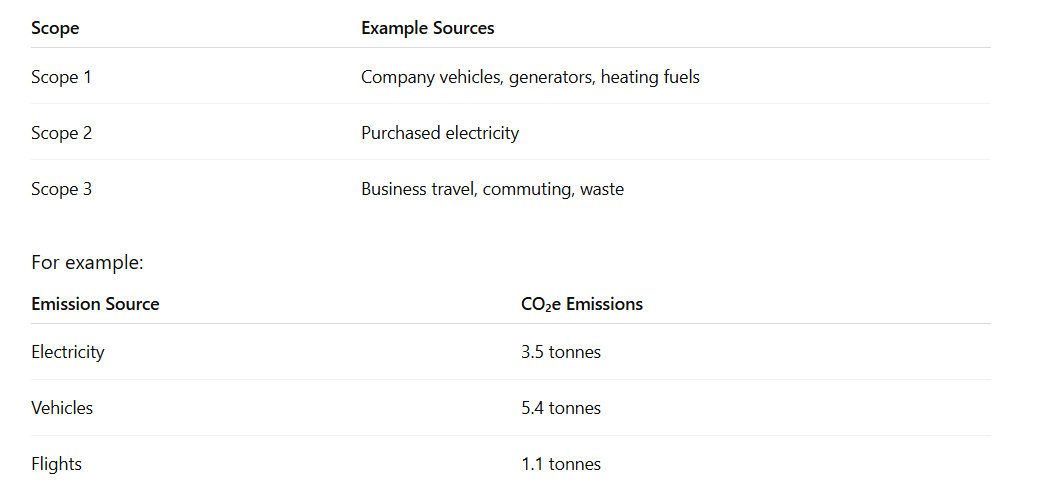
Total Carbon Emissions = 10 tonnes CO₂e
This figure represents the organisation’s carbon footprint for the reporting period, usually one financial year.
Step 5: Prepare Your Carbon Report
The final step is preparing your carbon emissions report.
A typical carbon report includes:
Total emissions in tonnes of CO₂ equivalent (tCO₂e)
Breakdown by Scope 1, Scope 2, and Scope 3
The reporting period
Data sources and methodology
Emission factors used
Any assumptions made in the calculations
Companies often use this report to:
Meet ESG reporting requirements
Demonstrate sustainability commitments
Track progress against carbon reduction targets
Support investor and stakeholder transparency
Regular carbon reporting allows organisations to monitor trends and identify opportunities to reduce emissions over time.
Why Carbon Reporting Matters for Businesses
Carbon reporting is rapidly becoming a key requirement across many industries.
Organisations that measure their carbon footprint can:
Identify energy inefficiencies
Reduce operational costs
Improve sustainability credentials
Prepare for environmental regulations
Strengthen ESG performance
Many businesses now include carbon reporting as part of their annual sustainability or ESG reports.
Frequently Asked Questions About Carbon Reporting
What is carbon reporting?
Carbon reporting is the process of measuring and disclosing greenhouse gas emissions produced by an organisation’s activities.
It helps companies understand their environmental impact and identify opportunities to reduce emissions.
What is the difference between Scope 1, Scope 2, and Scope 3 emissions?
Scope 1 emissions come from direct sources controlled by the organisation, such as fuel combustion.
Scope 2 emissions come from purchased energy, such as electricity.
Scope 3 emissions include indirect emissions across the supply chain, such as travel, logistics, and purchased goods.
Do small businesses need carbon reporting?
While not always mandatory, many small businesses are increasingly required to provide carbon data to customers, investors, or supply chain partners.
Carbon reporting also helps businesses identify ways to reduce energy costs.
How often should companies calculate their carbon emissions?
Most organisations calculate their carbon footprint annually, typically aligned with their financial reporting period.
And finally….
Calculating your organisation’s carbon footprint does not need to be complicated. By defining your boundaries, collecting activity data, applying emission factors, and reporting the results, businesses can establish a clear and reliable carbon reporting process.
Following these five steps for carbon reporting provides the foundation needed to understand environmental impact, meet reporting requirements, and develop effective carbon reduction strategies.