

Tree Timidity: How Standing Back Helps Forests Thrive

Walk through certain forests and look up.
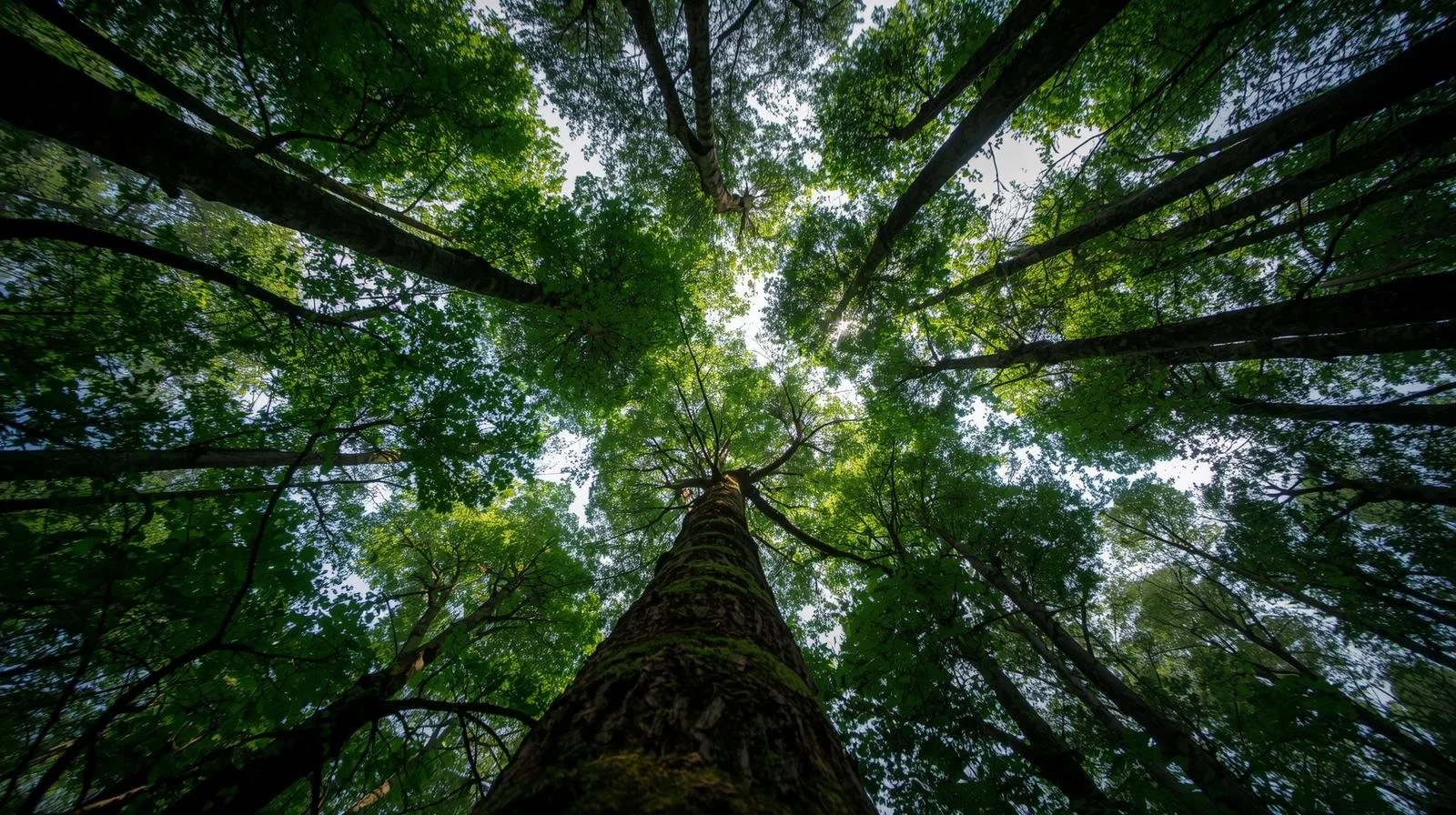
You might notice something unusual — the tops of the trees don’t quite touch. Instead, their crowns stop just short of each other, leaving thin, winding gaps of sky between them.
This natural phenomenon is called tree timidity, and it may be one of nature’s quietest — and smartest — survival strategies.
What Is Tree Timidity?
Tree timidity (also known as crown shyness) occurs when the uppermost branches of neighboring trees avoid touching one another. The result is a canopy that looks almost like a puzzle, with clearly defined borders between tree crowns.
It’s been observed in various species around the world, including:
Eucalyptus
Sitka spruce
Lodgepole pine
Black mangrove
Certain tropical rainforest trees
Rather than forming a dense, interwoven canopy, these trees maintain respectful space between themselves.
But why?
Why Do Trees Keep Their Distance?
Scientists have proposed several explanations — and the truth may be a combination of all of them.
1. Preventing Physical Damage
When trees sway in the wind, branches rub against each other. Repeated friction can damage delicate growing tips and bark.
By limiting contact with neighboring trees, they reduce mechanical damage and conserve energy that would otherwise go into repair.
In other words: less friction, less harm.
2. Reducing the Spread of Pests and Disease
Connected canopies make it easier for insects, fungi, and parasites to travel from tree to tree.
Maintaining small gaps may act as a natural barrier, slowing the spread of infestations and pathogens. This spatial separation could help protect entire sections of forest.
3. Maximizing Light Efficiency
Sunlight is a limited resource in forests.
When tree crowns avoid overlapping, more light can penetrate deeper into the canopy and reach lower leaves. This may improve photosynthesis efficiency for the forest as a whole.
Instead of competing aggressively for every inch of sky, trees may be optimizing the shared environment.
4. Sensory Awareness and Growth Signals
Some researchers believe trees can detect nearby neighbors through light sensing and chemical signaling. Subtle changes in light wavelengths reflected from nearby leaves may trigger growth adjustments.
In this way, trees may “sense” proximity and redirect growth away from competition zones.
It’s not conscious — but it’s remarkably strategic.
A Forest Built on Balance
Tree timidity challenges the common assumption that survival in nature is purely about competition.
Yes, trees compete — for light, nutrients, water, and space. But crown shyness suggests that cooperation and boundary-setting also play important roles.
By avoiding excessive overlap:
Damage is minimized
Disease spread is reduced
Light is distributed more efficiently
Energy is conserved
The forest becomes more stable and resilient.
A Broader Lesson from Nature
Tree timidity is a reminder that survival doesn’t always mean dominance.
Sometimes, thriving depends on balance — knowing when to grow, when to adapt, and when to leave space.
Nature often operates on systems thinking. What benefits the whole ecosystem can also benefit the individual organism within it.
And perhaps that’s the most fascinating part:
Without planning, without communication in the human sense, forests organize themselves into efficient, resilient networks.
They stand tall — but not too close.